Simon Doyle–Jacqueline de Bellefort murder-suicide
Death on the NileThe Simon Doyle–Jacqueline de Bellefort murder-suicide is the final violent turn in the investigation aboard the Karnak steamship: Jacqueline kills Simon while he is being taken away, then dies by suicide with a second pistol. The act brings their shared role in Linnet Doyle’s murder into the open and resolves the mystery of why the weapon used to implicate Jacqueline had been removed from the crime scene. Its ending joins revelation to consequence: the murder plot is exposed, but neither conspirator survives to face its aftermath.
Causes and Reconstruction
The deaths follow a reversal in the detectives’ understanding of Linnet Doyle’s murder. Hercule Poirot and Colonel Race had initially imagined a crime committed on impulse: someone wished to remove Linnet, overheard Jacqueline and Simon’s exchange in the saloon, and took Jacqueline’s pistol after the others had left. That explanation seemed to make the weapon and the letter J on the wall point directly to Jacqueline. But the pistol had then been thrown overboard, an action that did not fit the apparent attempt to incriminate her. Poirot treated this mismatch as a reason to abandon the first theory rather than discard the awkward fact.
The revised account made the murder a carefully planned and timed crime, not a sudden opportunity. Poirot recognized that he, too, had been kept from the night’s events: his wine bottle had been drugged so that he would be asleep. The detail mattered because he drank wine, while Mrs. Allerton drank water and Tim Allerton whisky and soda. In his final reconstruction, the narcotic was one of the arrangements made in advance to prevent his involvement. The weapon’s removal, initially an apparent contradiction, became evidence that the murder had required a particular sequence of actions.
The Two Pistols
The explanation of the final scene depends on distinguishing Jacqueline’s two pistols. One had been found in Rosalie Otterbourne’s handbag on the day of the search. Poirot later explained that Jacqueline, seated at the same table as Rosalie, had slipped it into the handbag when she realized a search was coming. She subsequently recovered it from Rosalie’s cabin by diverting her attention with a comparison of lipsticks. Because Jacqueline and her cabin had already been searched the previous day, they were not searched again.
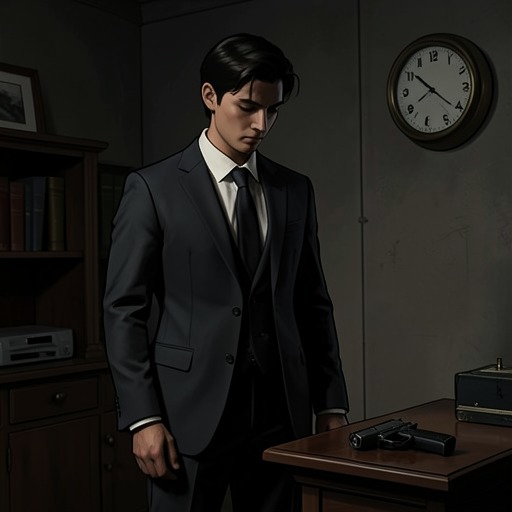
That pistol’s temporary placement in Rosalie’s bag explains how the search could have implicated another passenger while leaving Jacqueline able to recover the weapon. It also supplies the concrete basis for Poirot’s realization that Jacqueline had possessed a pair. The pistol used in the final act is not the weapon whose removal had puzzled him: it is the other one, which Jacqueline still has when the deaths occur. In this way, the last scene answers the investigation’s central material question without undoing the clues that had made the first theory seem persuasive.
The Final Act
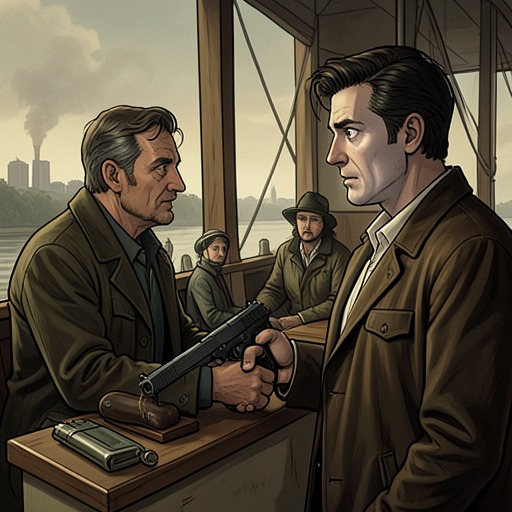
After Jacqueline says that the game has been lost, she stands aside as the bearer takes hold of the stretcher handles. She bends down as if to tie her shoe, reaches to the top of her stocking, and straightens with a pistol in her hand. She fires at Simon. Jacqueline then remains standing briefly, holding the weapon, and gives Hercule Poirot a fleeting smile. When Colonel Race moves toward her, she turns the pistol against herself and fires. She sinks to the floor; the scene leaves both Simon and Jacqueline dead.
The sequence is decisive in its order. Jacqueline first kills Simon, then turns the same weapon on herself; her death is not a separate later episode but the immediate completion of the paired act. Her earlier movement toward her stocking and the pistol’s appearance there make the second weapon visible at the moment it changes the outcome. Until then, the investigation’s attention had centered on the missing pistol and its power to frame her. Now the concealed weapon becomes the means by which the two central participants die.
Consequences and Significance
Afterward, Mrs. Allerton asks Hercule Poirot whether he knew Jacqueline had another pistol. He explains the discovery in Rosalie’s handbag, Jacqueline’s recovery of it, and the failure to search her again. He also says that he wanted Jacqueline to take that way out, but that she would not take it alone. His explanation connects the final deaths to his understanding of her choice without erasing the difference between the two actions: Simon is killed by Jacqueline, and she then kills herself. Mrs. Allerton’s response is to reflect on love’s capacity to become frightening, while her gaze turns to Tim Allerton and Rosalie Otterbourne standing together in the sunlight.
The ending closes the plot by making the missing pistol intelligible and confirming the disastrous bond between Jacqueline and Simon. It also gives the investigation’s method its final test: an explanation must account for the facts that resist the first theory, including the weapon’s removal and the existence of another pistol. Yet the answer does not restore what the crime has destroyed. The investigation can reconstruct the plan and identify the sequence, but its resolution arrives through two deaths. Afterward, the passengers go ashore, and the bodies of Louise Bourget and Salome Otterbourne are also carried off the ship, marking the wider toll of the case as the voyage ends.